Maureen Seltzer: The Paper Keeper of Franklin County
The otter came together slowly, carefully, one torn piece of paper at a time. At Funkytown Fest in Franklinton last month, while the crowd drifted between food trucks and craft tables, Maureen Seltzer pulled a canvas from her bag, already painted with the outline of the animal at play in a river, and went to work right there in the open. Her hands moved fast over a container of hand-colored paper, tearing off strips no bigger than a fingernail, laying each one down with a dab of glue and a flick of the brush. "I found myself moving towards animals more lately," she said, not looking up, already reaching for the next scrap. Within minutes the sketch had fur, current, and light on the water, built entirely out of torn paper and a steady hand
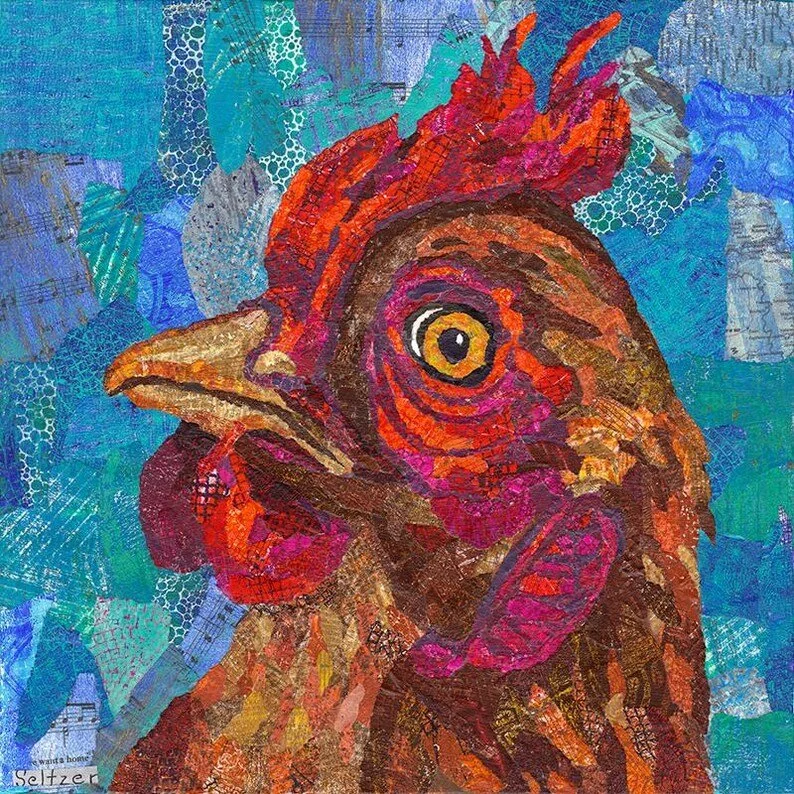
Ask her about that process and she will walk you through the whole thing, start to finish, the way she has for library crowds and festival strangers for years. "I usually have an idea in my head first," she says, "and it will get triggered by almost anything." A photograph scrolling past on Pinterest. A friend's snapshot from a trip out west. A song she cannot shake. From there comes a sketch, then an underpainting, and only then does she turn to the paper itself, digging through the boxes she keeps at home for something that already fits, or firing up her gelatin plate to print something new.
"The colors, I try to stick close to the realistic when I actually do the collage work," she explains. "When I'm in print mode, the papers are very abstract." She likes working both ends of that spectrum in the same piece, wild underneath and precise on top, chaos doing the quiet work of holding up order. Once a piece is finished, she seals it by hand, chasing out every trapped bubble of air, then lets it cure a full day before the last coat of UV varnish goes on, the kind that will not yellow. "It's on there," she says, with the satisfaction of someone closing a lid tight. "It's not going anywhere."
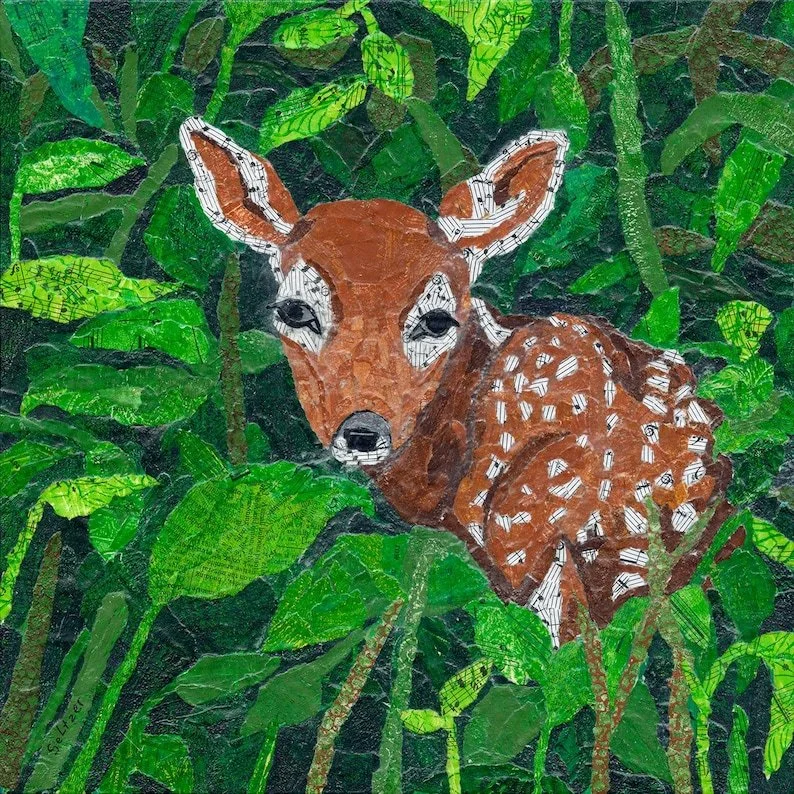
Her subjects may be the point, but it is almost always the paper that gets there first. A stack of 1949 Pennsylvania temple bank notes, handed to her with no explanation at all, sent her down a research rabbit hole on cars from that model year until she found the one worth drawing over them. A Beatles song turned into a walrus built from French newspaper and the actual sheet music for "I Am the Walrus," a piece she calls a little "off track," and clearly delights in. A stack of dictionary pages, every one turned to the definition of raven, became the quiet backdrop behind a print of the bird itself. Even a stranger's Facebook photo was fair game, a bear caught mid-nap in a tree in Yellowstone. "I was like immediately texting her," Maureen says. "Can I have permission to use that photo? Please."
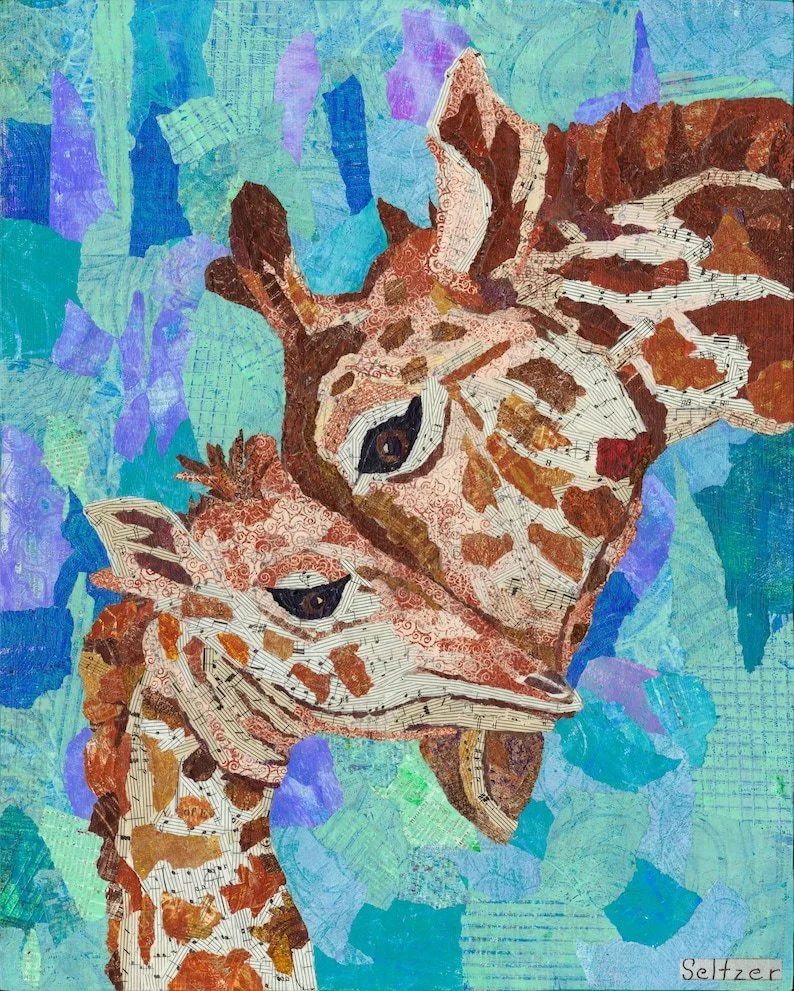
Some paper carries more weight than the rest. Once, a woman waited until a crowd cleared out after a library demonstration, then approached with a story instead of a question. "I have a whole bunch of music in my trunk," she told Maureen. "It was my father's. He was a musician and he passed away recently, and I just cannot throw it out. I am not musical. Could you use it?" Maureen said yes, and the woman came back with his old leather case, still stuffed with sheet music. He had been a saxophone player, and Maureen has known for a long time exactly what wants to be made from those pages. She has not made it yet. "I don't know what I'm waiting for," she says, turning the question over out loud, more to herself than to anyone listening. "It just feels very emotional for me to get started."
Maureen grew up in Raliegh as the daughter of a man who bought old houses. "My dad was the original flipper," she says, laughing at how far ahead of the trend he was, creative in his own restless way with wood instead of paint. Her mother ran the crafting side of the house, generous enough to turn her four children loose in a corner stocked with supplies, so long as the mess stayed put. "I can't imagine ever not doing creative things," Maureen says of growing up under that roof.
The family eventually settled on land her parents bought in Franklin County, and Maureen has circled back to that stretch of the county more than once since, most recently to a house outside Youngsville she has called home for twenty-five years. "We're not gonna be here permanently," she remembers telling herself the day she and her husband moved in. Now, decades later, she just laughs at the thought. "I think it's permanent now."
Her education took a stranger turn than most artists'. Garner Senior High, where she went straight through from junior high to graduation, was chosen for an experiment in specialized schooling that turned it into one of the state's first arts magnet programs. "They poured a lot of money into it," she says, "and I was very fortunate. We had potter's wheels and big looms. That's probably how I got through high school. If I'd been in a regular high school, I probably wouldn't have made it."
College pulled her a different direction entirely. She wanted to teach art, but her parents pushed her toward something with a steadier paycheck, so she headed north to study industrial photographic science, learning to shoot high-speed film that could freeze a bullet mid-flight through a pane of glass, the kind of photography factories once relied on to catch machinery moving faster than the human eye could follow. She worked in research and development at Polaroid before coming home to North Carolina, where she raised four children and spent the better part of a decade running the darkroom for the Wake Weekly.
Homeschooling came next, then part-time preschool teaching, and then the phone call that quietly reshaped the rest of her life. She dialed up the Town of Wake Forest and told them plainly, "You have no programming for your little kids. Here's my idea." That one conversation grew into decades of teaching, a rotation that now stretches from a mom-and-me class for toddlers all the way to lessons for grown adults, with preschoolers, after-schoolers, and teenagers filling in everywhere between. For a while she taught with the City of Raleigh too, running five summer camps in Wake Forest and four more in Raleigh in the same stretch of one summer. "I was a little insane," she admits, and does not sound entirely sorry about it.
COVID shut the world down not long after, and for Maureen, the stillness that frightened so many people arrived instead like a gift. "That gave me time to stop and think," she says. "I had to reorganize my life." At the time she was running the artist loft above a local coffee shop, building out studio and gallery space for a rotating cast of artists, work that pulled her attention in a dozen directions at once.
What she chose to keep, when everything else got weighed, was the printmaking and collage work quietly taking over her practice. Twenty years of watercolor had left her bored with its ceiling, unable to wring out the texture she wanted. Teaching a printmaking unit to her students sent her looking for a cheaper, safer method, and she landed on gelatin printing. "From making all the papers," she says, "I was like, what am I gonna do with all these papers now? And so then I started collaging them." A piece can still take its entire direction from whatever material happens to land in her hands, which is exactly how she likes it.
Ask what she would tell a young artist starting out and she does not pause. "Keep studying. Go to school. Major in business, minor in art," she says. "You need the business. I wish I had done that." Then, just as fast: "Don't be afraid. Don't be timid." She has spent years coaxing shy artists out of the loft's back rooms and into the front windows where people could actually watch them work, and she has kept learning herself well into her sixties, teaching herself search engine tags with help from a chatbot, leaning on her grandchildren whenever the technology outruns her. "Who would've thought an old lady would learn that stuff?" she says, laughing at herself. "But you got to. It's a tool. You gotta move with how technology moves, which is difficult for people my age."
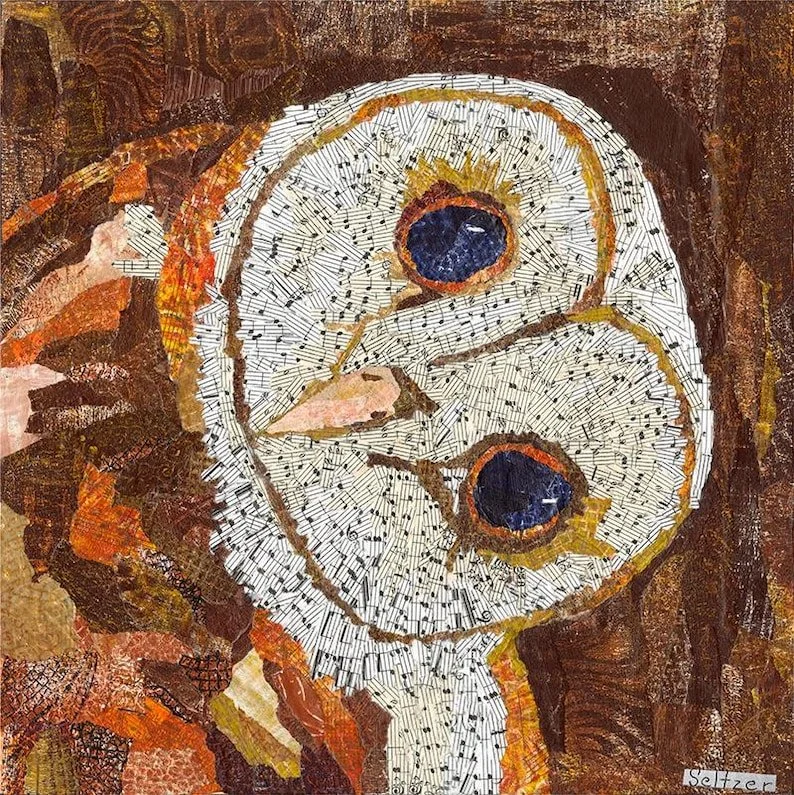
What she protects now, above everything else, is her time, because she has already learned exactly what it costs to spend it carelessly. She let the loft go. She let the second full-time job go. She kept only the version of teaching that fits around the work she was put here to do, instead of the version that crowds it out. It has not always been an easy trade, and by her own account, some months it still is not. But watch her at a festival table long enough, tearing paper into place with that same unhurried patience, and the trade looks less like a sacrifice than a homecoming. She is, by her own measure, exactly where she is supposed to be, turning a stranger's grief, a stack of old bank notes, or a Beatles song into something worth hanging on a wall, one careful scrap at a time.
Maureen Seltzer’s work can be found online at her website and through her Etsy shop. Be sure to give her a follow on Facebook and Instagram.
