
Organic Matter: The Ceramic Sculpture of Devi Murray
Beneath a house in Louisburg, everything was accumulated with intention: towers of neatly stacked packing material, a chest freezer holding works-in-progress in careful suspension, clay in various stages of becoming. Shelves hold creatures that don't quite have names in the natural world: a brain trailing thorned vines, a creeping figure whose lumpy cortex is studded with craters and squiggles, an eyeball fringed with teeth. A wheel sits at the center of it all.
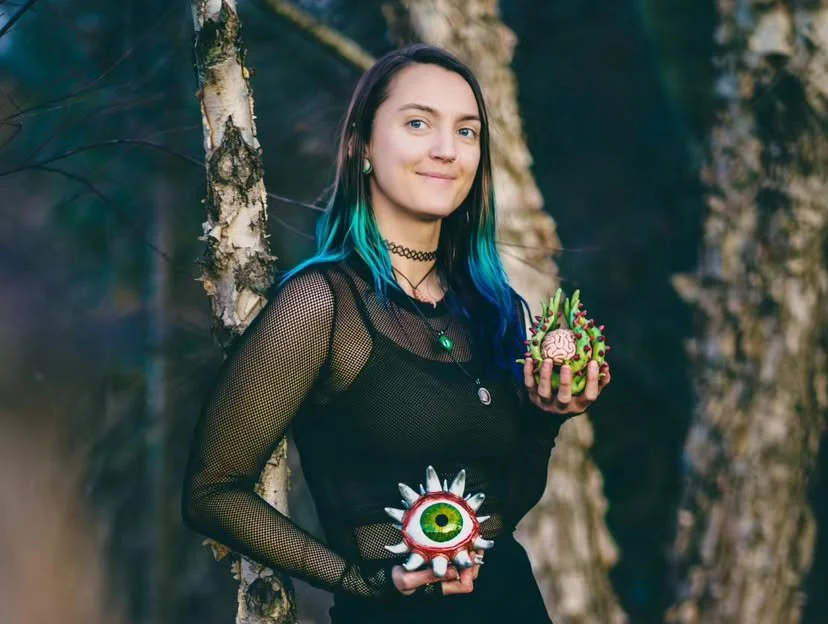
Devi Murray, 27 Sisters Studio's founder and ceramicist, stands among it with the casual ownership of someone who has built a world piece by piece and knows exactly where every piece lives. She’s warm, fast-talking and funny in the way of someone who has had to laugh at hard things for a long time. When she picks up one of the brain sculptures, she cradles it like something living.
"Can I touch him?" I ask.
"Oh, for sure," she says.
Murray didn't come to Louisburg looking for anything in particular, except maybe ground to stand on. When she and her partner began searching for a house where she could help care for her parents alongside raising her own children, they didn't draw a circle on a map and point to Franklin County. They simply looked everywhere: Virginia, both Carolinas, and points between, until something fit. What they found was a house with a full basement. The basement became the studio. The studio became everything.
"We were literally just looking anywhere on the map," she says. "And then we found this house and it just worked out."
Fate is a running theme in Murray's life as an artist. She didn't discover art until high school and when she did it was photography that caught her first. She went to Fayetteville State University certain she would become a high school photography teacher. Until a sculpture class led her away from the dark room's particular creative magic.
"Oh, forget photography," she says, her voice carrying the finality of someone describing a closed door. What she had loved about photography, she realized, was in the creation: her hands in the process and the matter of the thing. Sculpture gave her that in full. She graduated in 2017 with a Bachelor's degree in sculpture. She’s put her hands to work ever since, experimenting with organic shapes and forms that have come to define her unique style.
After graduation Murray found herself at the Tri-State Sculpture Conference, a yearly gathering where sculptors from Virginia, North Carolina, and South Carolina convene to make work and compare notes. Here she met a production potter whose work was loose and oceanic. Murray apprenticed with her, learning the rhythms of a working pottery business: the wholesale orders, the glazes, the discipline of turning out functional objects at scale. When her mentor had to relocate suddenly, she left Murray something more valuable than wages: her wheel and her kiln.
With a kiln and a wheel in hand, Murray and her sister, also born on the 27th, just a different month, launched 27 Sisters Studio. They started with the practical vocabulary of beach-themed ceramics. The kind that sells well at markets: lace-pressed surfaces, easy glazes and coastal shorthand. But something in Murray needed an edge and a strangeness. One day her sister pressed a tentacle onto a piece. They stared at each other wide eyed.
"People love them," Murray says. "They do take a long time." She timed herself once and discovered that attaching suction cups to a single mug handle takes thirty minutes.
The sculptures are something else entirely. They occupy a middle space that Murray describes with a kind of affectionate frustration: too strange for the potters, too domestic for her sculptor friends who are out there welding six-foot steel works for outdoor exhibitions. "I'm just in this weird middle ground where I don't really fit into either party."
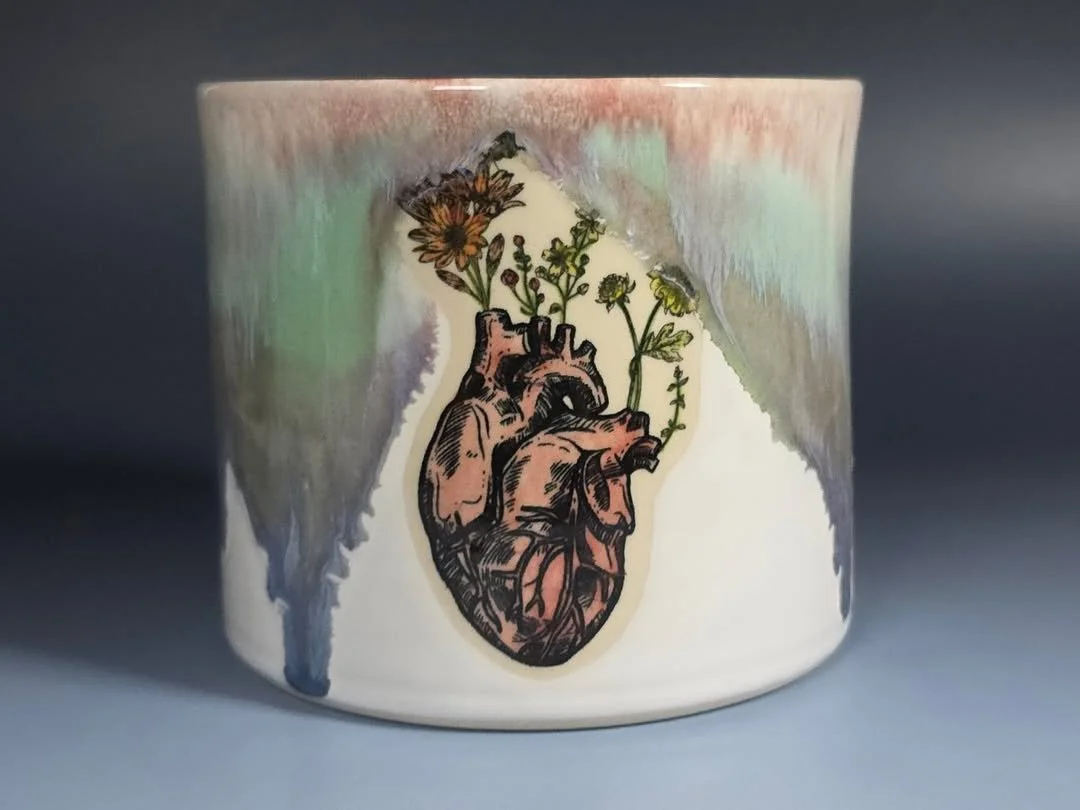
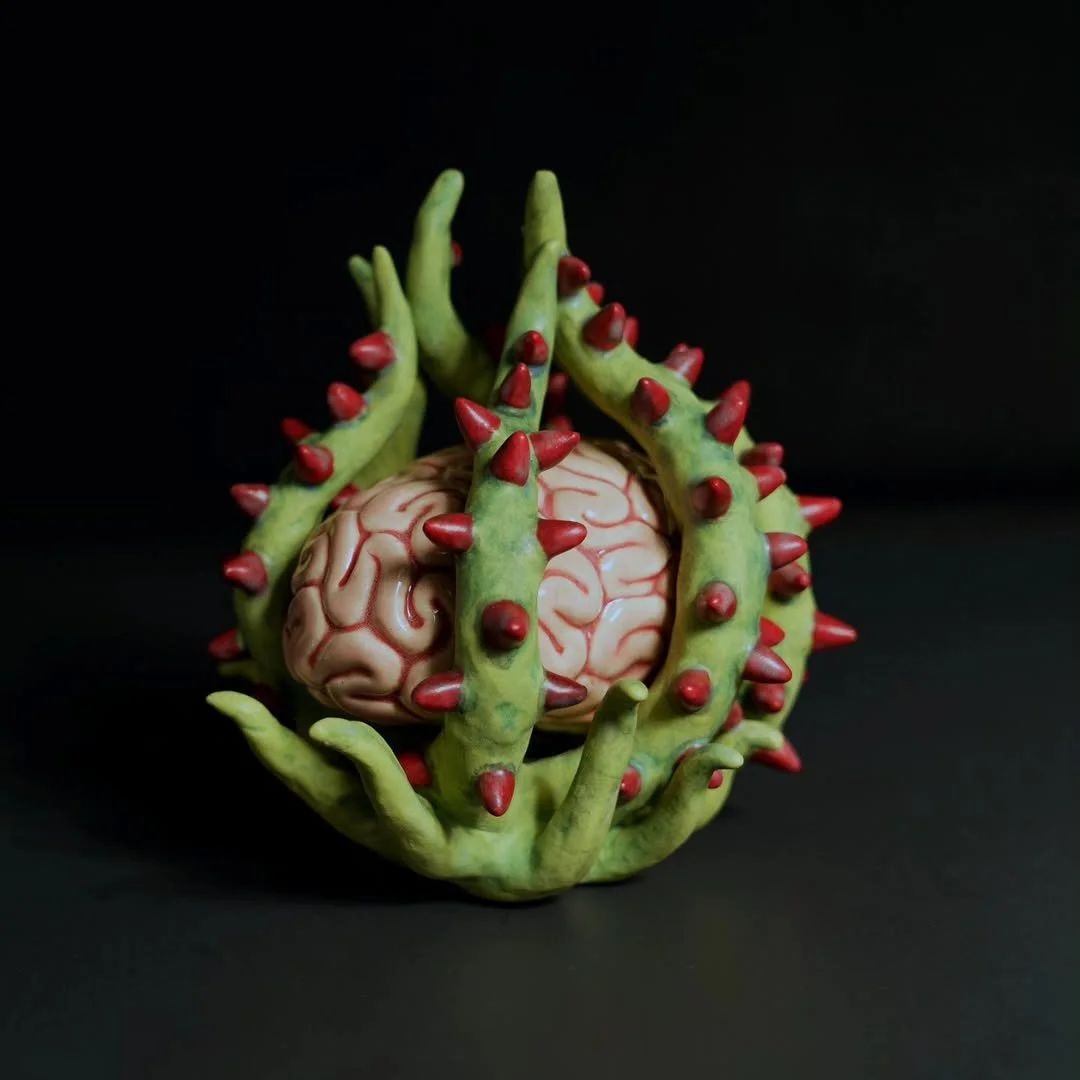
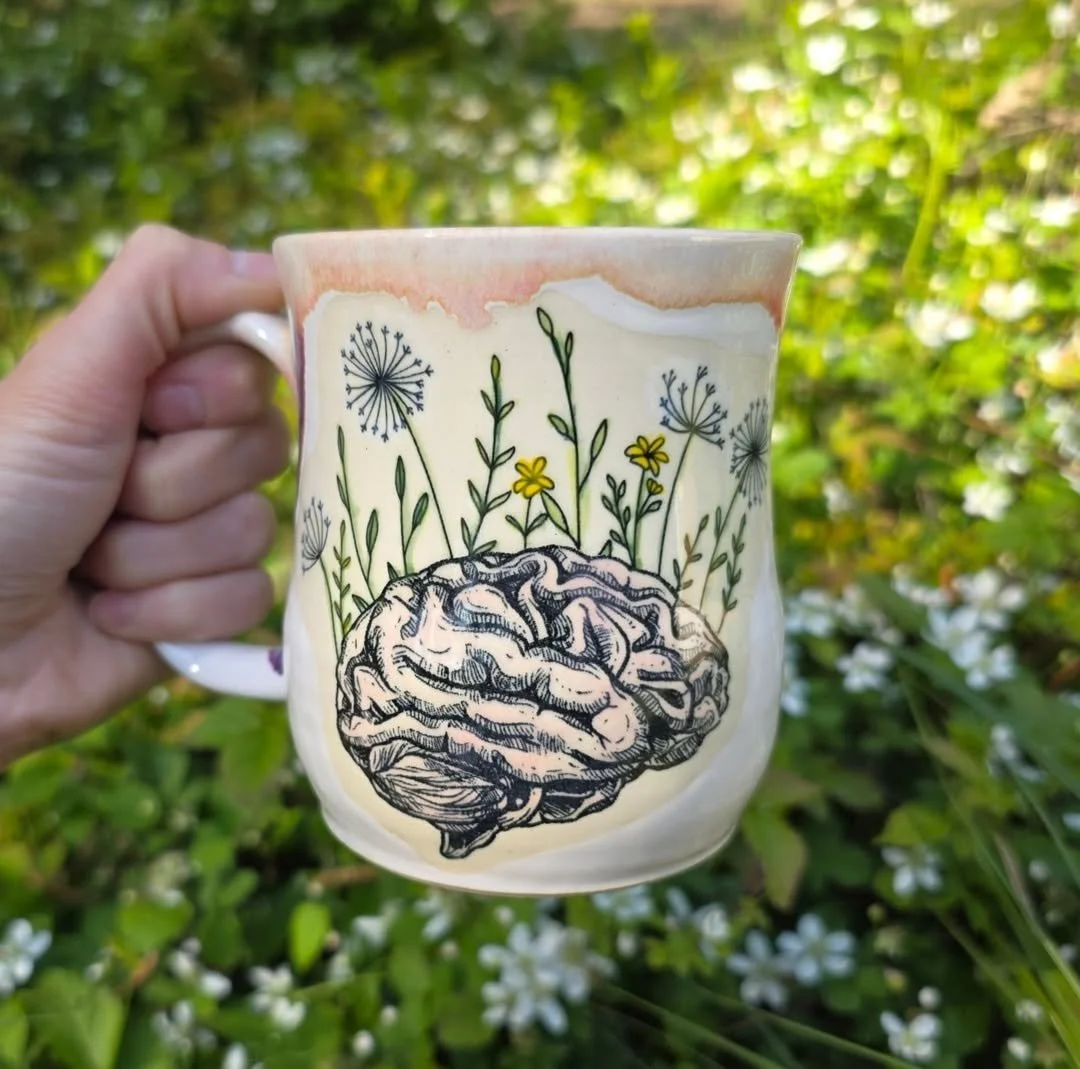
What she makes in that middle ground is unsettling and tender in equal measure. The brains began as pure form. The college work stacked on her shelf now shows the timeline: spray-foam creatures on wire armatures that her professor kept pushing toward ceramics, forms that evolved into something more confessional. Murray describes herself as an emotional person, one who has had to learn the hard way how to move through anxiety, through the difficulty of handling people, through the accumulating weight of caring for others while also trying to create things.
Brains became a language for that.
One sculpture, a self-portrait of sorts, depicts a heart being pulled apart, pieces of it handed outward. She titled it While Supplies Last. Another piece, a brain tangled in vines with thorns along the vines, she calls Boundaries, a piece about protecting her interior while also keeping the world at a certain distance. She's making a larger version now, a two-part series: one half armored with thorns, the other half blooming with flowers.
"I love that my work still has the same ideas as what I was doing in college," she says. "It's just a little more refined."
In 2021, Murray received an Artist Support Grant from the NC Arts Council, the one she describes evangelizing about at every event she attends, calling herself "the unofficial representative." The grant got her ceramics business off the ground in a real way. She received it again in 2023 this time specifically to fund the brain sculptures materials to build a body of work around emotional interiority, around what the mind holds and protects and lets go of.,
When asked what she'd tell artists just starting out, Murray doesn't hesitate. “Apply for the Artist Support Grant” she says, but do it right: go to the workshops, attend the Q&As, talk to people who have done it before. "Make it about the art," she says. "Not about why you need the thing." Network locally, show up to conferences like the Tri-State, bring a piece to the pop-up exhibits. Let other artists look at your applications. "Artist friends are great because they can help you with your applications," she says, "and be like, hey, is this the right way to ask for that?" Get out of your studio. Find your people. Ask for help before you need it.
The life of a working artist in rural North Carolina, caring for parents, raising children, managing a household, learning to find the groove on any given afternoon before it slips away again is not the life of her sculptor friends who hold professorships, do residencies and travel light. Murray knows this. She is humorous about it and also honest. Some days she gets downstairs, gets into her rhythm, and has to stop to pick up a kid from school.
"If I wasn't lollygagging, I'd have way more productive time," she says, and grins. The basement is still cool. The brains are in the freezer. The wheel is waiting.
There is a particular piece on the shelf that catches the eye before it can be explained. It crawls, or seems to, its stumpy legs a little too earnest, its brainy surface full of craters and loops. Murray made it bigger because she decided it needed more presence, longer legs and more room to creep. She can't entirely
explain why she loves it as much as she does. Some things don't have titles yet. Some things just arrive in the hands and ask to become something,
and the artist's job is to say yes. Devi Murray has been saying “yes” down in her basement in Louisburg
for a while now. She intends to keep doing it.
27 Sisters Studio ceramics are available through Etsy and at regional events. Follow Devi Murray's work on Instagram and Facebook.
