
When the Town of Franklinton invited Marti King to its board meeting on Sept. 15, 2026, she was fairly certain she had the evening figured out. She serves on the town's Tree and Bee committee because she has a soft spot for green, growing, buzzing things, and she figured the committee had a part for her in the Christmas parade. "I honestly thought that they may ask me to be a bumblebee on our float," she says. She learned afterward that the town really does keep a bumblebee costume tucked away somewhere.
Instead, Mayor Art Wright presented her with a Key to the City. He told the room that Marti turns up at nearly every town function and called her one of the most devoted cheerleaders Franklinton and its people have. "It was a complete surprise," she says. "They said all these things about me." She won't be donning the bumblebee suit this Christmas after all, because the town has asked her to lead its parade as grand marshal.
Marti is 89, with her 90th birthday waiting next May. She grew up without much faith in her own talent, and for years it took the steady encouragement of others to keep a brush in her hand. She has spent the decades since paying that kindness forward, and she suspects that is what the town was really honoring. "That could be one of the reasons I got the key to the city," she says. "I love to support other people."
Marti was born in 1937 near Heidelberg, Germany, and was raised by her grandparents in a small town ringed by castles and old villages, where during the war art supplies were simply not to be had. "We had no paper, no colored pencils when I grew up," she says. "I just found scraps sometimes, laying around, and I would draw." Her mother married an American GI and left for the United States in 1946, and from across the ocean she tucked every drawing Marti made in 1947, 1948 and 1949 into a shoe box. Marti did not know the box existed until after her mother died. She keeps it still. She came to America at 17, learned English, studied theology and spent time as an inner-city missionary in Atlanta before she took up painting in earnest in the late 1960s. "I've always wanted to make a difference," she says.
She began in oils while living in Georgia until the fumes from the paints and cleaners of that era left her with pounding headaches. "Everything smelled really bad," she says. Watercolor, with its light and its looseness, had always called to her more anyway. Her first serious teacher, a well-known painter there, eventually sent her packing. "She kicked me out," Marti says. "You need to be on your own. You need to teach." For years, though, she gave away nearly everything she painted, until friends began to gently insist otherwise. "People said, Marti, you need to enter your paintings, you need to do events," she says.
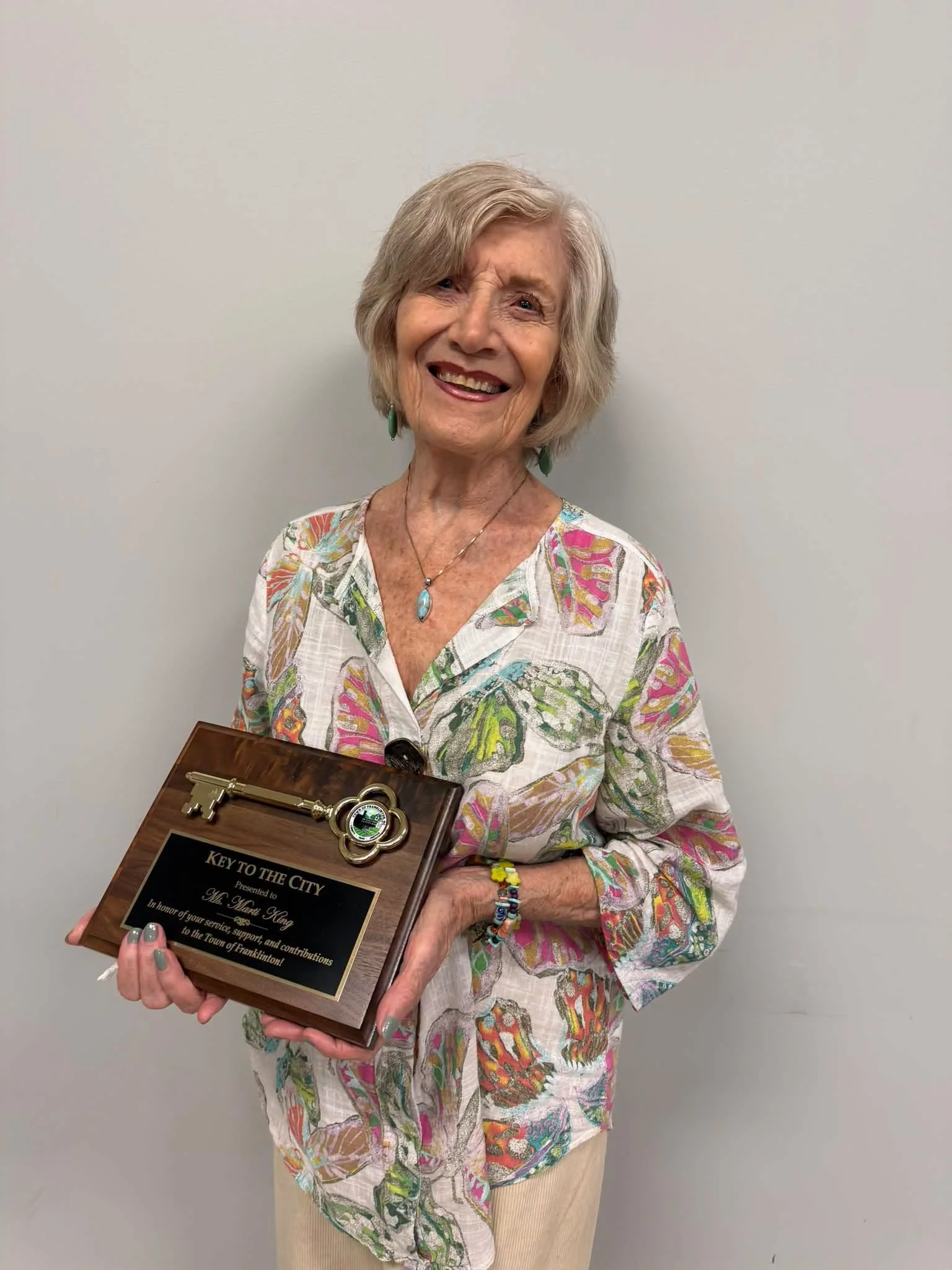
King recieves the Franklinton Key to the City (photo credit: Town of Franklinton)
She came to North Carolina carrying a personal loss that had caused her to re-evaluate her next steps. She had long dreamed of building her own home, with a studio upstairs and big windows to let the outdoors in, and in 1996 she found affordable land in a gated community a couple of miles outside Franklinton. Living on her own, she felt safe behind the gate. She moved in on Nov. 27, 1996, the day before Thanksgiving. "I made my dream come true," she says. "It was so great."
In North Carolina she found the mentor she credits with teaching her watercolor technique, the Louisburg artist Mabel Allen. Mabel had traveled a long road to Franklin County herself. Born in Baton Rouge in 1922 and raised on a Louisiana sugar plantation, she earned a fine arts degree from Tulane's Newcomb College in 1944, worked as a draftsman at an aircraft plant during the war, and moved to Louisburg in 1967 to teach art in the Franklin County schools. After she retired she kept painting and teaching from her home, often one student at a time - just as she did with Marti.
Mabel was known for watercolors and sketches that captured a scene in a few spare strokes of brush or pen, and in 1981 she illustrated a history of Louisburg's Person Place. She was just as well known for giving her paintings away to family, friends and whoever happened up her walk, a habit Marti shared for years. "Not every artist that paints can teach," Marti says. "You can go and have a teacher that is the best in your field, and yet you can't learn." When Marti had her first art show, a bouquet arrived from Mabel. Mabel died in 2015 at 92, and Marti still speaks of her as the teacher who finally made sense of watercolor for her.
Marti joined the Franklin County Arts Council around 1998, when its office sat near Louisburg College, and filled the years that followed with juried shows, the Piedmont Chorale, kayak trips down wild rivers, running and tennis.
Franklinton was a sleepier place when she arrived. When downtown began to bloom with small shops years later, someone from the women's club reached out and invited her to join, and Marti took it as her way into the life of the town. She started welcoming newcomers and pointing them toward the shops. "I'm just a natural, passionate, enthusiastic person," she says. Her grandparents raised her to keep her word, and she credits her faith for the rest. "I was so thankful for the gifts that God gave me, and I always wanted to share those gifts."
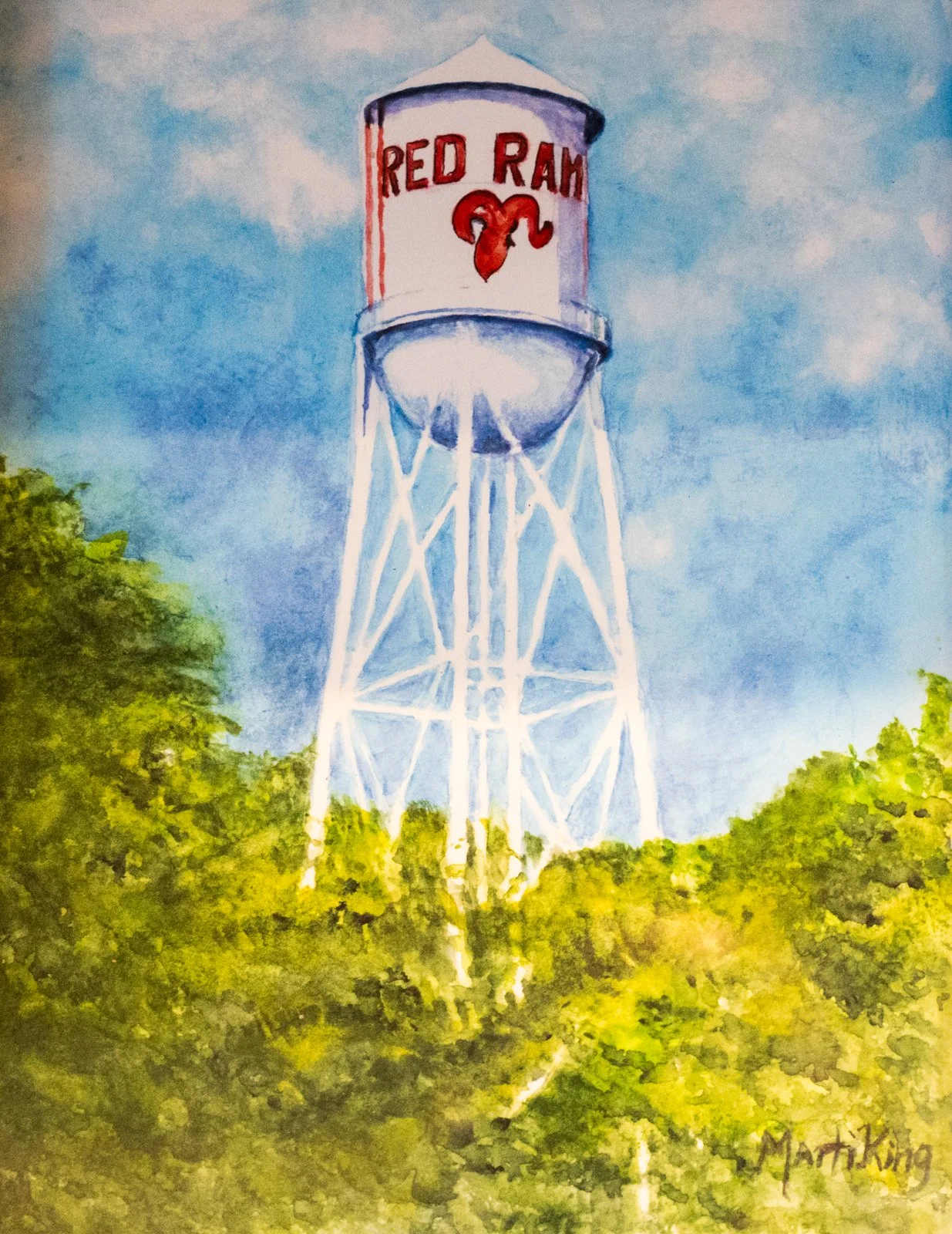
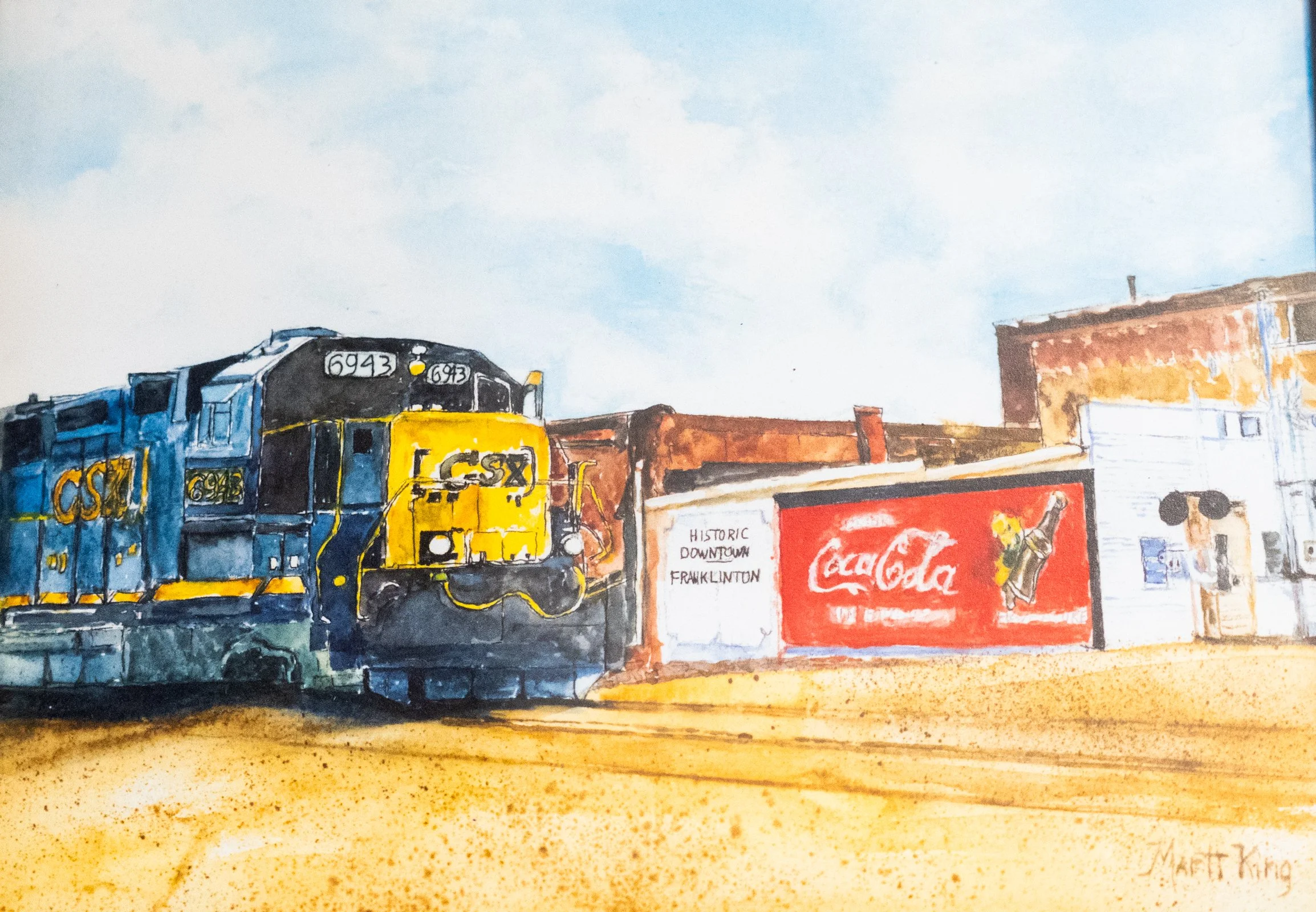
One of those gifts became a series of historic Franklinton scenes, painted, she says, as a love letter to the town. Benchmark Community Bank bought the series, and the paintings now hang in the branch. Anyone who lingers in front of them can see what she cherishes most. "I love details," she says.
The paintings also brought people to her door. Folks read about the series and called her, and now some of them wind their way out to her studio, about two miles from town, to do their Christmas shopping. This season she has been filling her days with small paintings for a holiday bazaar, since the local shop that used to carry her work has closed its doors.
Over the years, folks in town started calling her the ambassador. She sits on the town's Tree and Bee committee, and she gives paintings to local fundraisers, most recently one for breast cancer. Back in the days of the old International Whistlers Convention in Louisburg, her work hung in the auditorium alongside that of her late friend Billy Farmer, a watercolorist she still speaks of with real admiration. For Marti, the work of an artist and the work of a good neighbor have always been braided together. "When you do something in life, like you're with the arts, and you represent, people get to know you," she says. "I love the town."
Germany holds a share of her work, too. For years she flew back to visit friends with a suitcase full of unframed watercolors and sold them at German festivals, where the occasional beer sloshed onto her table. The sales usually paid for her plane ticket. On one visit she lay down on the cobblestones to sketch a window and a sliver of roofline, painted it, and came back two years later to sell scenes of that same town to the very people who lived there. An art collector bought several pieces. "It's nothing like I'm known throughout the world or anything," she says, "but I have made a difference in some little towns in Germany with my work."
She paints wherever her mood leads, and it wanders often. A painstaking architectural piece usually sends her to flowers next, loose and quick, and she drifts among watercolor, acrylic, oil and alcohol ink on tile and Yupo paper. She traces that push and pull to her upbringing. "When you've been brought up in a country like Germany, you tend to be analytical and organized," she says. "We did everything at the same time every day, and we were never late for anything." Her children taught her to loosen her grip, and the lesson found its way into her painting. "They helped me just open up and be loose," she says. Alcohol ink, with its blooms of runaway color, suits that side of her. She says she was one of three artists in Wake Forest who started working in it, back when people warned them it would be forgotten in two or three years. "Now it's worldwide," she says. "So you never know."
She no longer enters competitions, because hauling large framed paintings from show to show is hard work at 89, and she does not care to ask for help. "I'm sort of independent," she says. She also believes her turn in the spotlight has passed. "I'm happy for other people that are entering their paintings," she says. "That's something I did a long time ago, and now it's time to let someone else shine."
She has stopped measuring her work in ribbons. "I don't have to enter my paintings to validate them," she says. The praise that matters most to her now comes from closer to home. "Doug, you know, my soulmate," she says. "He's the biggest encourager of all. He just praises me all the time, and everything I do."
She never trained as a teacher, and she came to it later in life. "I love teaching because it's something I wanted to do, but I wasn't educated in teaching," she says. She got her start leading classes at Green Hill, and one Christmas season she taught wine glass painting at the stables to groups of 12 or 14. Her biggest class ever numbered 24 students. She prefers small, close-knit groups now, and she often starts beginners on alcohol ink, because the colors are gorgeous and the medium forgives an unsure hand. "Even people that have very little experience in art, it's easy for them," she says.
These days she teaches out of her home studio, where six women gather once a month. Some of them had never picked up a pencil before their first class, and several have been coming for years. "It's a joy to see them develop," she says. Whenever she talks about slowing down, they talk her right out of it. Her advice for anyone starting out is plain and kind. "Put your heart into it and use your own style, but always be open to learning," she says. "It's difficult to start, but you have to start somewhere. Maybe take some basic lessons from someone, and then just keep going."
Even an interview becomes a lesson in her company. When Marti asked if I paint at all, and I confessed that watercolor frustrates me but that I like to sketch, Marti had a suggestion at the ready. "You take a very fine ink pen, and you sketch something," she said. "And then you take the watercolor, and you kind of wash over it a little bit." She was not about to let the idea drop. "Just try it one day," she said.
The kayak trips down wild rivers are behind her now, and so are the juried shows, but she has no plans to put down her brushes. "I will probably paint until the Lord takes me home," she says. "I just can't stay away from it." First, though, she has a parade to lead. The girl who drew on scraps of paper in a sleepy German town, and who needed her friends to convince her the work was worth showing, will lead the Christmas parade as grand marshal of the small North Carolina town she chose for herself in 1996.
Marti King teaches small classes from her home studio outside Franklinton. Her historic Franklinton scenes can be seen at Benchmark Community Bank.
