
Where the Music Lives: Eric McCracken’s Quiet Stewardship of Culture
Driving down a quiet Louisburg Road, you may not expect to find a house that looks as though it has stepped forward from the eighteenth century and settled comfortably into the present. Yet there it stands, painted a warm, confident yellow, its chimneys rising above the trees with a kind of unhurried assurance. The garden surrounding the house hosts native pollinator beds filled with milkweed, coneflower, and bee balm that draws butterflies and bees in steady measure. The gravel drive bends gently toward it and by the time you reach the front steps, past pots of native plants for sale, you get the distinct feeling of arriving somewhere with a long memory.
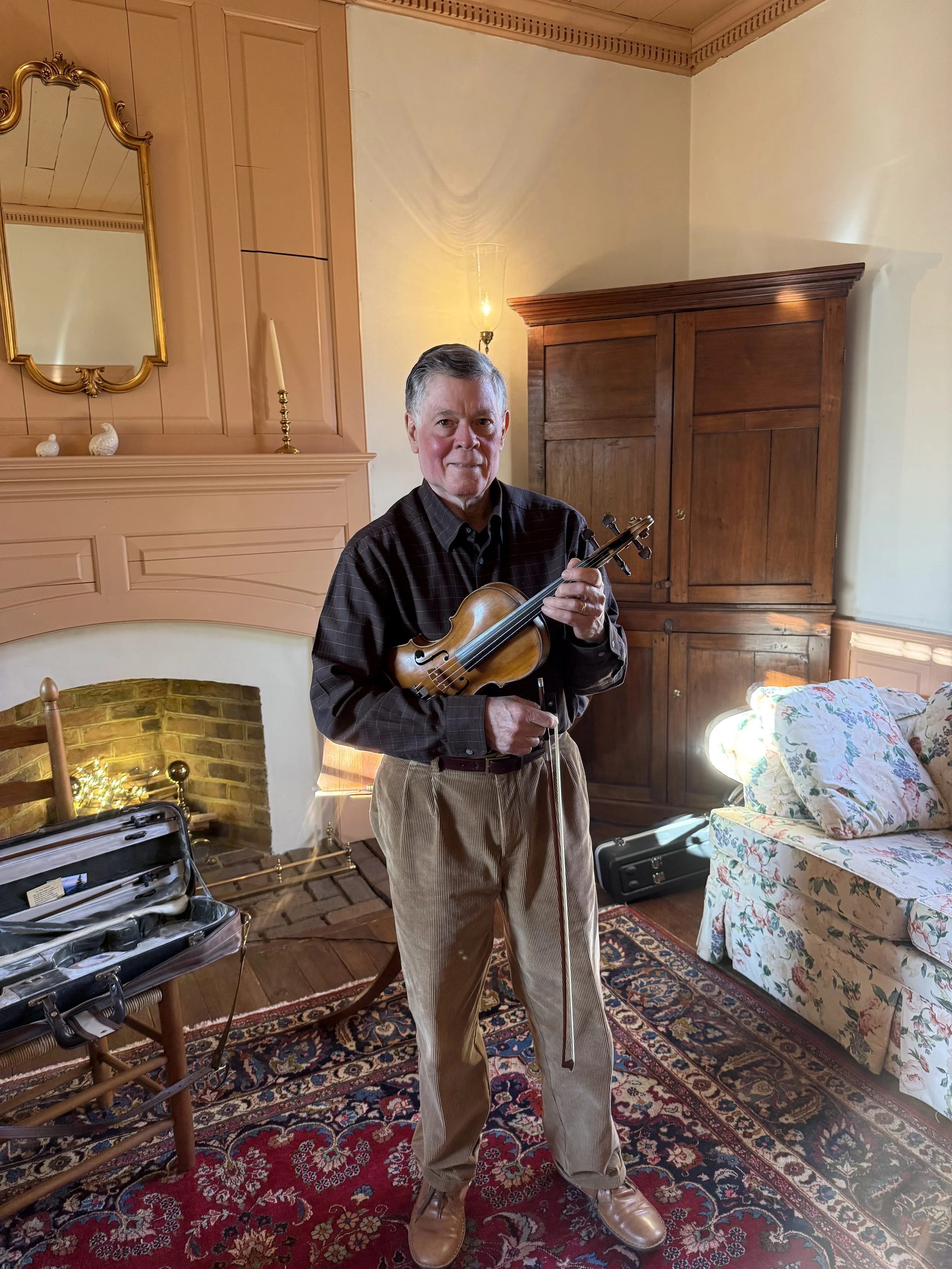
When I walked through the door at Portridge Farms and sat down with violinist Eric McCracken and his wife, Janice McCracken, I was met with an interior that matched - antique furniture collected across the years, carefully cared for wooden floors, and beautiful artwork decorating the walls. The desire for cultural preservation, and bringing it into the present, is a theme that carries across Eric’s life. Their approach to restoration is deliberate. “It’s been in maintenance,” Eric says simply. “We’ve kept up on the painting, and there’s always something that’s going.” Rather than add on to the structure and compromise its character, they worked within it. The kitchen was created in an English basement of handmade brick so that the authenticity remained intact. “They didn’t want to destroy the historical integrity of the house by adding to the building,” Janice explains. “So they simply created the English basement.”
When the brick walls felt too dark, Eric whitewashed them. “It’s so much more,” she says, smiling at the transformation. Air conditioning registers are hidden behind custom wooden vents so as to not interrupt the flow of ceiling design. Each decision has been measured against a single question: does this honor what was here before?
A tall timber-frame structure stands across the lawn that once resembled little more than a weathered tobacco barn. Eric found it on a farm near Centerville and saw not what it was, but what it could become. He had it moved to the property and restored it largely by hand, reshaping rough timber into a functional outbuilding that now feels entirely at home beside the eighteenth-century house. The narrow stair treads inside reflect the proportions of another era, and he smiles when he notes that people must have been smaller then. What he does not emphasize is the patience required to bring such a structure back to life.
The physical restoration of old buildings mirrors another devotion that has defined Eric’s life: music.
He began studying violin at nine years old in California public schools. “By the time I was about twelve, I knew I wanted to be a professional musician,” he says. “It was just, other than medicine, that was the only thing that I was really interested in.” He practiced with intensity, joining youth orchestras and chamber groups, shaping his teenage years around discipline and practice. While other interests flickered and faded, the pursuit of musical perfection remained steady.
When Eric speaks about his mentors, the steadiness in his voice shifts almost imperceptibly. He can describe repertoire and acoustics with crisp clarity, but when he recalls the teachers who shaped him, something softer enters the room. He recalls former teacher Fred Ohlendorf as “a dear, dear man,” someone who genuinely cared about the musical education the next generation and made them feel seen before they ever felt accomplished. He speaks, too, of the formidable Vera Barstow, whose standards were unyielding and whose insistence on precision left no space for laziness. Everything had to be right, not for ego, but for the music itself. His eyes grow bright as he talks about those years of being a boy with a violin and the adults that believed he could rise to something higher and he pauses just a moment longer than usual. It is clear that what moved him was not only their skill, but their sacrifice as they handed him a tradition and trusted him to carry it forward, and even decades later, the memory of that trust touches him deeply.
His pursuit of music carried him across the country. In California, he absorbed the influence of studio musicians and world-class performers drawn to Los Angeles. On the East Coast he encountered a different intensity, a cultural expectation that demanded precision and rigor. He married Janice, herself raised in a deeply musical family and together they built a life shaped by sound.
He has played in opera productions, symphonic performances, and chamber settings, but his most memorable concert was in Carnegie Hall. “The acoustics in Carnegie Hall, there’s nothing,” he says searching for the right word. “There’s nothing like it.” He remembers looking out into the distinctive horseshoe-shaped auditorium and realizing he was standing where some of the world’s greatest artists had performed. “To think that there were those who wanted to tear it down,” he adds, shaking his head. For him, playing there was not simply a professional milestone. It was participation in a cultural inheritance.
When asked what he loves most about playing he said “For me, being able to create the sound and to… the feelings I have for the music to be able to produce it,” he says. “The process of transferring what’s inside of me emotionally.” The violin is, in his words, a means of turning something internal into something shared.
In recent years, Eric has devoted increasing energy to teaching. His studio, housed on the historic Portridge grounds, welcomes students of all ages. He has taught beginners whose hands are still learning how to hold a bow and advanced players who aspire to conservatory-level training. He takes what he calls a long view, understanding that excellence cannot be rushed. He is demanding, though not impatient, and he believes that students should ultimately produce a sound that people want to hear. If a teacher is strict, he tells aspiring professionals, they should be grateful. The path is competitive, and the standard continues to rise.
There was a season not long ago when Eric feared that his playing days might be over. Physical limitations made it difficult to hold the violin, and the interruption struck at the core of his identity. Through months of therapy and persistent effort, he gradually returned to the instrument and made a powerful comeback, followed by further engagements and renewed confidence. The experience deepened his appreciation for the simple act of playing. During seasonal festivals hosted at Portridge, Eric often plays outdoors while visitors wander Portridge and pursue artisan booths and blooming paths. He’s also played with his wife at weddings throughout the years. They’ve even developed a music coordination service to ensure that ceremonies move with grace and precision, reflecting his belief that details matter.
For those just beginning, Eric offers grounded advice. “If you want to be successful in music and you have a tough teacher, be thankful,” he says. He tells young musicians that the violin is a lifelong companion, not a quick pursuit, and that steady, daily practice builds more confidence than flashes of talent ever could. Excellence, he explains, is something you grow into with patience and good guidance. He encourages students to seek out teachers who challenge them, because thoughtful correction is a gift that sharpens both skill and character. The musical world is full of opportunity for those who are willing to work carefully and consistently. Most of all, he reminds them to fall in love with the sound itself. If you learn to enjoy the process of drawing a beautiful tone from the instrument, the rest has a way of unfolding in its own time.
Now, after decades on stage and in practice rooms from California to Carnegie Hall, Eric McCracken finds himself in a season of invitation. The door to his studio is open again, and with it comes the quiet promise of discipline, encouragement, and high standards rooted in love for the art itself. He welcomes beginners whose hands are still learning the weight of a bow and advancing players who feel the tug toward something more serious. What he offers is not shortcuts or spectacle, but careful guidance shaped by mentors who once invested in him. In a county growing faster by the day, Eric is extending something steady and enduring: a place where culture is practiced, preserved, and passed forward, one student at a time.
For more information about The Garden at Portridge, which hosts festivals along with native pollinator plants at the McCracken’s home, visit their website , Facebook or Instagram. For information about Eric’s teaching services see his Facebook page or email at music@portridgeltd.com
